Summary
- IT lifecycle services reduce IT costs by managing technology from purchase through retirement.
- Poor lifecycle management drives unnecessary spending through contract sprawl, support gaps, and reactive refreshes.
- Better asset visibility improves decisions around renewals, support, and hardware refreshes.
- A proactive lifecycle strategy strengthens compliance, security, and sustainability.
- A Cisco lifecycle assessment from GDT identifies cost-saving opportunities before they become expensive problems.
Why IT costs keep rising after the initial purchase
Most IT teams we talk to are feeling budget strain to some extent. OEM prices have gone up. Supply chain issues have made timing less predictable. And when every refresh decision gets scrutinized, there is little room for surprises. That makes a cost-effective IT lifecycle services strategy even more important.
Organizations cannot afford to get caught off guard by uncovered assets, surprise renewals, or gear that reaches end-of-support with no plan. Yet a lot of teams still treat procurement like the finish line and do not manage the rest of the lifecycle with the same discipline. Support coverage, contract dates, software renewals, hardware refresh timing, and end-of-life decisions all keep moving after the initial purchase.
When those recurring pieces are managed in a structured way, organizations can lower total cost of ownership, save money, improve uptime, reduce risk, strengthen asset visibility, and make compliance easier to manage.
What IT lifecycle services cover
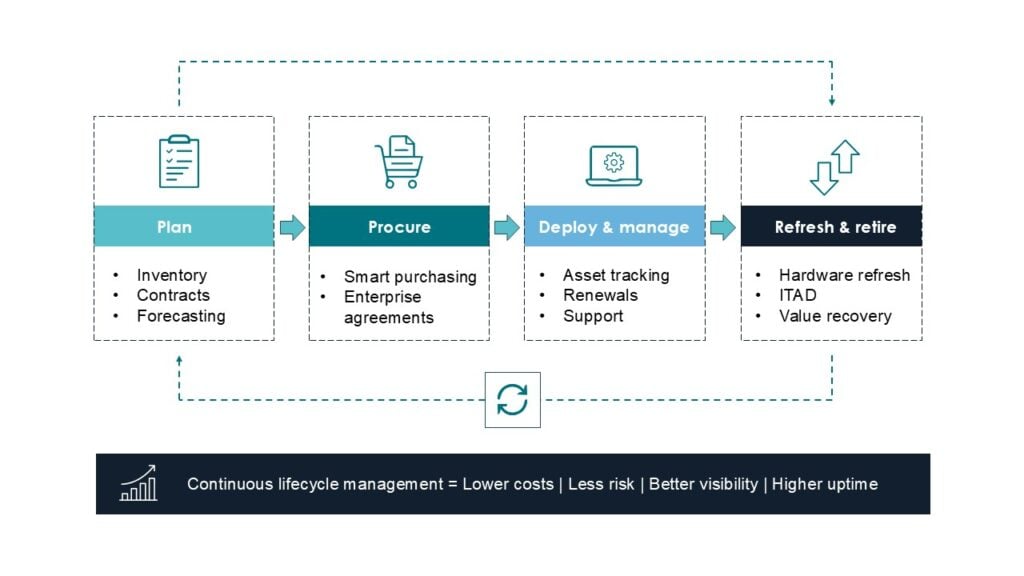
IT lifecycle services cover the full life of an asset from planning to retirement. A simple way to look at it is by stage:
- Planning: Understand what is in the environment, what is under support, what is coming due, and what the business actually needs.
- Procurement: Buy in a way that supports the full lifecycle, not just the initial transaction.
- Deployment and operations: Keep asset data current, maintain support coverage, and manage renewals before they become problems.
- Refresh and retirement: Decide when to replace, extend, or retire technology based on risk, budget, and business need.
This is also where IT asset management and IT asset lifecycle management start to separate.
IT asset management is the foundation. It tells you what you own, where it is, and whether it is covered. Lifecycle management takes that visibility and turns it into a strategy. It helps organizations align contracts, improve buying models, plan refreshes, and get more value out of the technology they already have.
Where poor lifecycle management creates waste
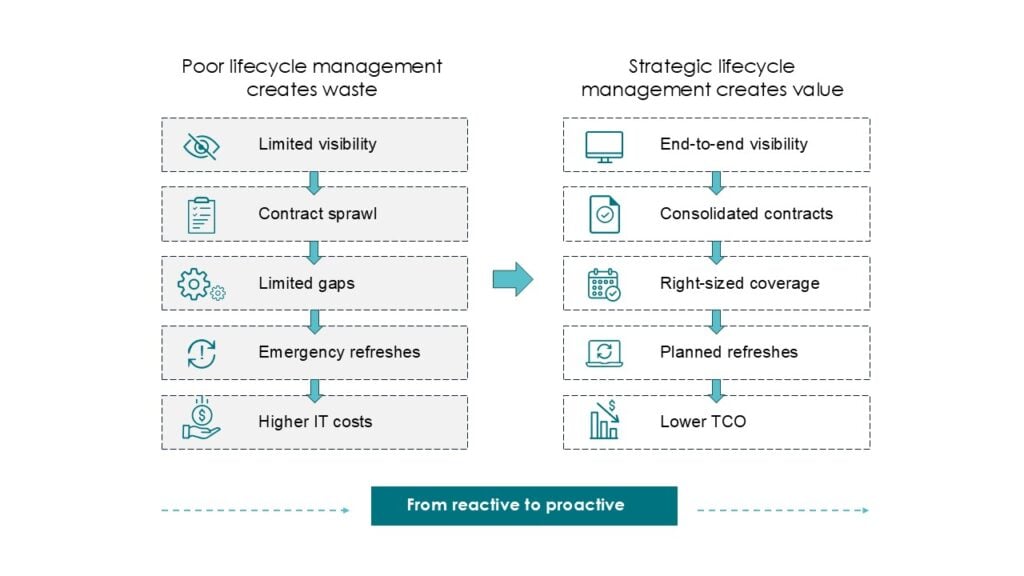
A lot of this waste starts with fragmentation.
In bigger organizations, lifecycle responsibility is usually spread across multiple teams, sometimes across multiple countries, and often across a variety of buying channels. You can end up with dozens of people participating in asset decisions, and for many of them, it is only one small part of their actual job. That is how contracts, support terms, and renewal dates start drifting apart.
From there, waste usually shows up in three places.
The first is contract and support sprawl. Instead of one coherent strategy, the organization ends up with a patchwork of contracts, end dates, support levels, and purchase events. That adds cost, creates administrative overhead, and makes it harder to negotiate and buy strategically.
The second is uncovered assets. Fragmented contracts and uncovered assets go hand in hand. The more scattered the environment is, the easier it is to miss something. Teams think an asset is covered until they try to open a case and find out it is not.
The third is delayed refreshes and surprise end-of-life costs. Every asset has a useful life, and every OEM support window ends eventually. If teams do not have a clear view of those dates and a plan in place, they end up making reactive replacement decisions on tighter timelines and with fewer (and possibly more expensive) options.
Visibility ties all of this together. If you cannot clearly see what is in the environment, what is covered, and what is coming due, it gets very hard to control cost.
How IT lifecycle services reduce cost at each stage
The best way to reduce cost is to manage it across the full lifecycle.
Planning and procurement
Some of the biggest savings opportunities show up early. Before organizations buy, they need a clear view of their environment, contract structure, and software position. From there, they can standardize where it makes sense, align contract dates, and choose buying models with lifecycle cost in mind.
Enterprise agreements can make a real difference here. The value is not just in visibility. It is in changing how customers buy and consume technology over time. For example, a True Forward can help Cisco customers defer some software and support costs until the anniversary date instead of paying everything up front. Value Shift gives them a way to move value from older products to new ones as their environment changes. When the right assets are enrolled in the right agreements, organizations can reduce friction, improve flexibility, and avoid unnecessary rebuying.
Operations
At the operations stage, cost control depends on accurate data and consistent management. Teams need current asset records, support status, and a clear view of coverage and utilization. If that data is incomplete, uncovered assets, duplicate spend, and support gaps show up fast.
Asset management tools like GDTamp can help by giving teams a single place to see assets, support status, and renewal exposure, so they can manage the environment more proactively.
It also helps to deal with end dates before they become emergencies. The earlier teams can see support expirations, underused assets, and SLA complexity, the easier it is to make better decisions without disrupting the business.
Hardware refresh and end-of-life
Hardware refresh decisions should be driven by business context, risk tolerance, and budget. For example, a healthcare organization, a financial institution, and a retail business have different compliance requirements, different tolerance for downtime, and different reasons for extending or replacing equipment.
That is why there is no one refresh rule that works for every environment. Some infrastructure supports revenue directly. Some supports internal operations. Some hardware can stay in place longer if the risk is understood. Other systems need to be refreshed earlier because the business cannot afford an outage. The key is to make those decisions proactively, not because a date showed up and forced the issue.
End-of-life should be structured, too. That includes secure retirement, responsible disposal, and, where it makes sense, value recovery. In some cases, organizations may use extended third-party support for a period of time while they work through a longer-term plan. In other cases, they may replace equipment before reaching end-of-life. A disciplined process helps reduce risk and keeps retirement from becoming an afterthought.
How IT lifecycle services support compliance and sustainability
Visibility also plays a key role in compliance and sustainability. Organizations need to know what assets they have, what software versions are running, what assets are under support, and what equipment is approaching end-of-support. Without that visibility, it is hard to secure or audit the environment effectively.
Secure equipment retirement is a big part of the picture. Memory-bearing devices must be handled carefully, and teams need confidence that data destruction is happening the right way. Structured IT asset disposition processes, certified recycling partners, and certificates of destruction help create that audit trail while protecting the organization and its customers from data breaches.
Sustainability follows the same logic. Responsible recycling matters, but so does getting the right value out of assets before retirement and making informed refresh decisions based on efficiency, risk, and business need. Sustainability also means looking at whether older equipment is still the right fit, how long it should stay in service, and whether value can be recovered through remarketing or buyback options as part of a broader lifecycle strategy.
Getting started with IT lifecycle services
The fastest way to get started with IT lifecycle services is to get the data and build a plan. That sounds simple, but it is where a lot of customers get stuck. The data you need includes:
- A current inventory of assets and software
- Contract and renewal data
- Support coverage details and end-of-support dates
- Maintenance history and refresh history
Once that data is in place, the first wins can come quickly. Teams can get a clearer handle on what is actually in the environment, what is being used, where support gaps exist, and where contracts are fragmented. From there, they can start turning basic visibility into a real strategy.
That is where a Cisco lifecycle assessment from GDT can help. This complimentary assessment combines an automated review of your Cisco environment with our deep Cisco buying program expertise. The assessment provides a clear picture of contract sprawl, support exposure, software positioning, and refresh risk. It gives you a starting point for what to do next.
For many organizations, that is also the point where programs like True Forward and Value Shift start to make sense, and they can evaluate those options without waiting for a renewal event. Many of our customers are shocked to see how many disparate contracts are in place and how many assets are out of support. Getting that view early is one of the fastest ways to reduce risk and save money. And you don’t need to wait for your next renewal event to get started.
The value of effective IT lifecycle services is pretty clear. IT costs and risk usually rise when the technology lifecycle is unmanaged. But when planning, procurement, operations, hardware refresh, and retirement are treated as one connected process, organizations are in a much better position to lower cost, improve uptime, and stay in control.
If you want to learn more our lifecycle assessment and how to get started, be sure to download the ebook, Driving ROI in an era of OEM pricing volatility.