
Summary
- Carrier-grade principles can make enterprise AI infrastructure more reliable by applying telecom-tested disciplines such as failure isolation, predictable performance, and rigorous change control.
- AI performance depends on more than GPU capacity. Network congestion, storage bottlenecks, and inefficient data movement can delay training, slow inference, and leave expensive compute resources idle.
- Failure domains help contain infrastructure issues by isolating AI clusters, fabrics, and operational planes so one fault does not disrupt the entire environment.
- End-to-end observability enables faster troubleshooting by giving teams visibility across networking, storage, compute, and platform layers before performance issues become outages.
- Enterprises can strengthen AI infrastructure without replacing everything by mapping failure domains, baselining performance, reviewing capacity, formalizing rollback plans, and creating cross-functional runbooks.
What enterprise AI infrastructure can learn from network operators
For thirty years, telecom operators have carried a burden most enterprises never had to think about: their network is the product. A dropped call, a lost packet, a five-minute outage during a maintenance window — these weren’t minor disruptions. They represented the business failing in real time, in front of millions of customers and under the scrutiny of regulators. That pressure gave rise to carrier-grade design: infrastructure engineered from day one to contain failures, deliver predictable performance, provide end-to-end visibility, and support change controls rigorous enough to survive a 2 a.m. software rollback gone wrong.
Enterprise AI infrastructure is arriving at that same inflection point today, just a few decades later and a lot faster. Yet, the question worth asking isn’t whether enterprises need to run their networks like telco operators. (They don’t.) Instead, enterprise IT leaders should be asking whether they need to start thinking like one.
The past: Why traditional enterprise IT falls short for AI infrastructure
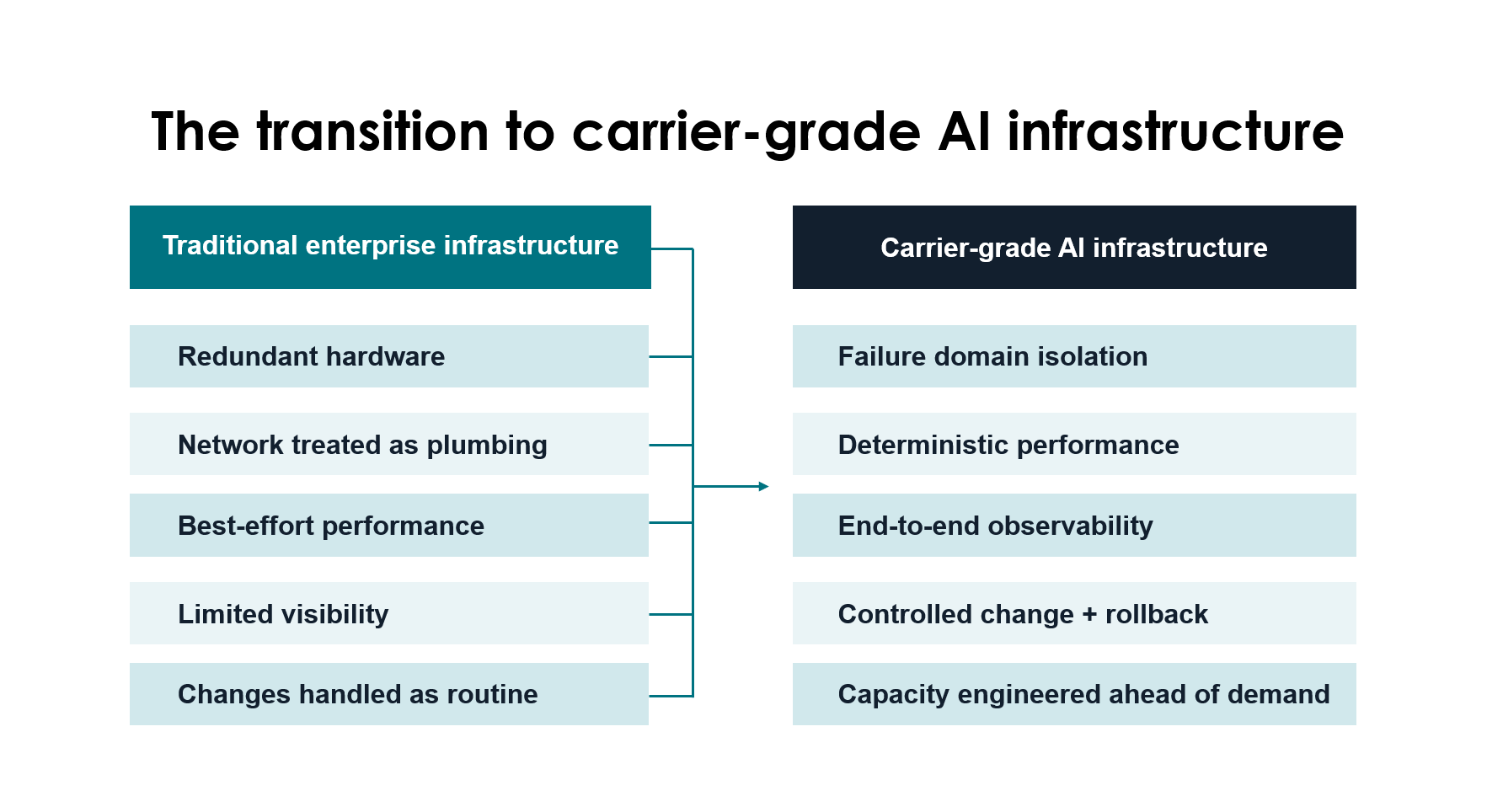
Many production AI environments in use today were built on the assumptions that have governed enterprise data centers for the past two decades: invest in redundant hardware, virtualize everything, treat the network as plumbing, and treat “available” as good enough. That model worked reasonably well for transactional applications and web workloads, where a few hundred milliseconds of latency variance or an occasional retransmit was invisible to the end user.
AI training and inference workloads are less forgiving of such inefficiencies. GPU clusters are only as fast as the AI fabric connecting them. A single congested link or an oversubscribed spine can silently stall a training job for hours, leaving every GPU in the cluster idle while it waits for data. This is increasingly behind reports of underperforming AI infrastructure. The problem is often not insufficient GPU capacity, but network and storage layers that were never designed for the throughput, predictable performance, and failure containment modern AI workloads require.
The present: AI performance depends on more than GPU capacity
The dominant AI infrastructure narrative of the last two years has been about compute scarcity: get the GPUs, get them installed, get the models running. That narrative is starting to correct itself. The organizations further along in their production AI journeys are learning what telcos learned decades ago: the network, storage, and operational model around compute are what determine whether that compute can consistently deliver performance and value.
A few carrier-grade principles are proving directly transferable right now.
1. Design around failure domains, not just device redundancy.
Telco engineering was never about duplicating hardware. It was about containing blast radius so that one fault doesn’t cascade into a regional outage. Applied to AI, that means isolating pods, clusters, and fabrics so a failure in one domain doesn’t take down training runs or inference services elsewhere, and separating management, storage, and data planes so a control-plane hiccup doesn’t become a data-plane outage.
2. Build for deterministic performance, not best-effort behavior.
Carrier networks are engineered around service assurance: known latency, known loss, and known throughput under maximum or over-subscribed loads. AI clusters need the same: predictable east-west traffic, low packet loss, and clearly understood oversubscription ratios. This isn’t a networking nicety; it directly shows up in model training efficiency, inference responsiveness, and ultimately whether the business trusts the platform enough to put real workloads on it.
3. Make observability part of architecture and not an afterthought.
Carrier-grade operations have always assumed telemetry is instrumented from day one, not bolted on after the first outage. AI environments need the same end-to-end visibility — across network fabric, transport, storage, compute, and platform layers — with baselines for normal behavior and thresholds for congestion, loss, and abnormal latency. This allows root causes of outages or degradation to be found in minutes across shared teams instead of days across silos.
4. Treat change as a reliability event.
Telcos plan maintenance windows, rollback paths, and stage changes as a matter of routine, because an uncontrolled change is how outages happen. Enterprises rolling out AI infrastructure updates need the same pre-change validation, sequencing, dependency awareness, and rollback criteria. An AI platform that breaks every time it’s touched isn’t operationally mature, no matter how good the architecture diagram looks.
5. Engineer capacity before demand forces it.
Carrier-grade operators don’t wait for a failure to reveal a design limit. Instead, they plan for data growth, model growth, traffic growth, and resilience overhead together, with network, optics, storage, and cooling in the same capacity conversation. AI readiness is as much about headroom and visibility as it is about pure raw compute. Assess your readiness before you start, not when you’re forced to.
Clusters, fabrics, and the data underneath them
These three areas are where carrier-grade thinking can be a proving ground and is most immediately valuable for enterprises building their own AI infrastructure today:
- AI cluster networking. Leaf-spine or equivalent high-bandwidth fabric design, predictable east-west traffic handling, non-blocking or low-oversubscription decisions, and optics and transport choices that support scale and consistency. Networking isn’t peripheral to AI performance but rather an integral equation that is ultimately responsible for the compute outcome.
- Storage and data movement. AI is a data movement problem as much as a compute problem. Storage throughput, data locality, replication behavior, and transport bottlenecks all determine whether GPUs are fed fast enough to stay busy, which is why storage and fabric planning needs to happen together, not in separate silos.
- Resilience across distributed environments. Many enterprises will run AI across core data centers, edge sites, partner environments, and regional facilities. Telco lessons around primary-secondary design, path diversity, failover planning, and service continuity map directly to that reality. Distributed AI infrastructure should inherit telecom-style thinking around latency, availability, and fallback architecture.
At the center of these considerations is a less glamorous but equally important question: can this environment be upgraded without disruption? Modular infrastructure choices, staged lifecycle planning, and disciplined software and firmware dependency management determine whether a refresh or scale-out puts the AI service at risk. If every infrastructure change jeopardizes a production AI environment, the architecture isn’t done yet — it’s just new.
The future: Operational maturity will define AI infrastructure success
Resilient architecture still fails if the operating model behind it remains immature. Over the next several years, enterprises will need to transition from designing for deployment day to designing for day 2, day 200, and the next major maintenance event.
This will require building runbooks for known failure modes and establishing cross-functional incident response between network, infrastructure, and platform teams. It also means putting real change governance around high-impact updates, running capacity reviews tied to actual workload growth, and treating every incident as an input to continuous validation rather than a one-off fire drill. Enterprises that skip this vital step will find that reference architecture doesn’t operate by itself. It requires people, processes, and tools to work harmoniously.
Five practical moves enterprises can make now — without rebuilding everything
Carrier-grade discipline doesn’t require a rip-and-replace of existing AI infrastructure. It requires a handful of deliberate, sequenced moves:
- Map failure domains across the current AI stack so you know where blast radius is contained and where it isn’t.
- Assess baseline traffic, latency, and congestion visibility. You can’t manage what you haven’t measured.
- Formalize change windows and rollback plans and treat every change as a reliability event, not a routine task.
- Review AI fabric oversubscription and capacity assumptions before demand exposes them under load.
- Develop cross-functional runbooks so an incident doesn’t become a silo-to-silo relay race across teams.
These steps don’t require new hardware. They require better telemetry, cleaner delineation of roles and responsibilities, proper segmentation of failure domains, tighter maintenance discipline, and shared ownership models across teams that too often operate independently today. Small changes, disproportionate payoff.
The bottom line
Enterprises don’t need telco scale, but they do need telco discipline. AI infrastructure becomes fragile the moment it’s treated as a one-time deployment instead of a continuously operated service — and the carrier-grade principles that have kept the backbone of the World Wide Web reliable for decades are exactly the disciplines that will make AI platforms more reliable, more observable, and easier to scale and upgrade. The compute race will keep making headlines. Enterprises that will eventually win and gain a competitive edge with AI at scale will be the ones that made an internal cultural shift to adopt a telco mindset by getting their operational fundamentals right.
FAQs: Carrier-grade for AI infrastructure
What is carrier-grade infrastructure?
Infrastructure engineered to telecom-operator standards of availability, predictability, and controlled failure and built around contained blast radius, deterministic performance, and rigorous change management vs. best-effort behavior.
What does carrier-grade mean for AI infrastructure?
Carrier-grade for AI infrastructure means applying the same disciplines such as failure domain isolation, deterministic network performance, built-in observability, and change-as-a-reliability-event thinking, to the network, storage, and compute layers underneath AI workloads.
Why is observability important in AI clusters?
AI performance problems are often invisible until they show up as stalled training runs or slow inference. A well-thought-out and deployed end-to-end telemetry across network, storage, compute, and platform layers allows teams to identify performance degradation issues early on and resolve root-cause issues in minutes instead of days.
How do telco design principles improve enterprise AI reliability?
They replace ad hoc redundancy with deliberate failure-domain containment, predictable performance engineering, and disciplined change control — the same practices that kept carrier networks available at massive scale for decades.
What causes AI infrastructure failures at scale?
Most commonly, AI infrastructure failures are caused by a network, storage, or capacity layer that was never designed for AI’s throughput and blast-radius requirements — not insufficient GPU capacity, which tends to get the blame first.
How can enterprises make AI infrastructure more resilient without rebuilding everything?
Enterprises can increase AI infrastructure resilience by mapping failure domains, baselining telemetry, formalizing change and rollback discipline, reviewing capacity assumptions, and building shared runbooks across teams — incremental moves that don’t require new hardware.